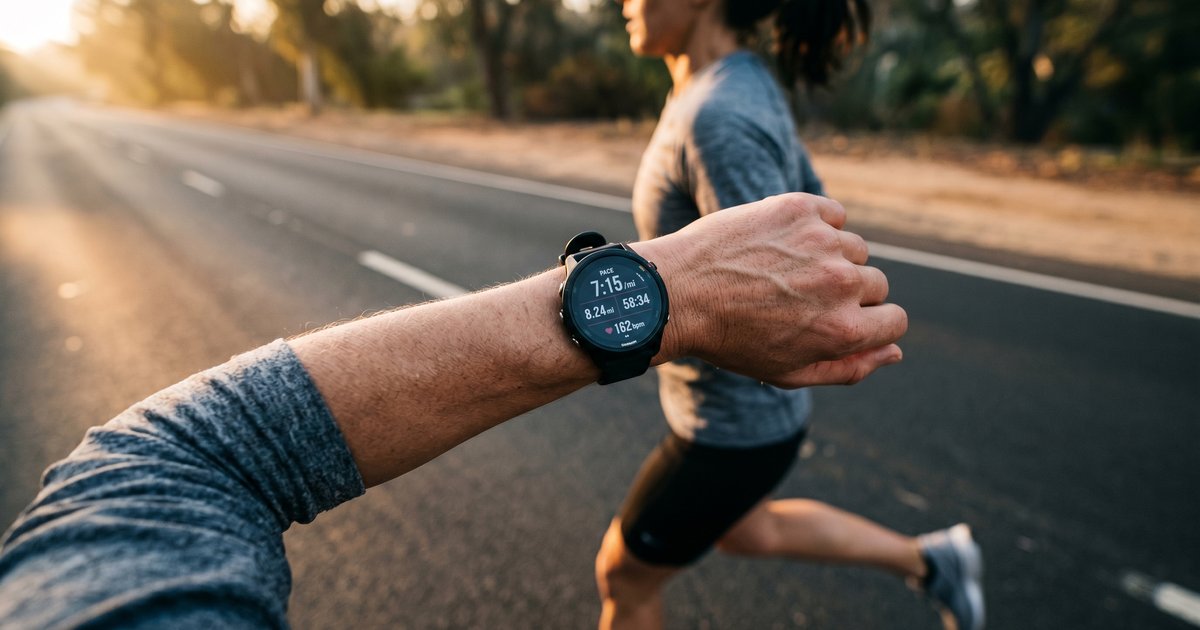
Pace Running Calculator
The math in a pace calculator is straightforward: divide your time by your distance to get your pace. A 5K in 25:00 gives you 5:00 per kilometer, or 8:03 per mile. Every calculator handles that arithmetic. The harder question that most pace calculators don’t address is what pace you should actually be running in the first place.
What a Pace Calculator Does
A pace calculator solves for whichever of three variables you’re missing: pace, distance, or time. Give it any two and it returns the third.
You can use it to figure out what pace you need to hold to hit a goal time, what time you’ll finish if you hold a specific pace, or how far you’d travel at a given pace over a set duration. The Pace Calculator handles all three cases in miles or kilometers instantly.
What that number doesn’t tell you is whether it’s the right pace for your workout, your fitness level, or your goals. That’s the gap most tools leave open.
Training Pace vs Race Pace
Your race pace is what you sustain from start to finish on race day. Your training paces are different numbers entirely, and using race pace as a template for daily training is one of the most reliable ways to stay injured and make no progress.
A runner targeting a 4:00 marathon (9:09/mile) should be running most easy days somewhere between 10:30 and 11:30/mile. Not 9:09. Running easy days at race effort means you arrive at hard workouts pre-fatigued, your body doesn’t fully adapt to the aerobic stimulus, and you gradually dig a hole you can’t race out of.
The ratio matters. Research on trained runners consistently shows 80% or more of weekly volume at genuinely easy effort, with only 20% at threshold or harder. Recreational runners tend to invert this, running every run at a medium-hard effort that’s too slow to build speed and too fast to build aerobic base.
Training Zones and the VDOT Framework
The most coherent system for assigning training paces comes from Dr. Jack Daniels, whose VDOT formula derives specific pace targets from race performances. His five training types correspond to distinct physiological adaptations:
Easy (E): True conversational pace. Aerobic base development and recovery. Should make up 60-80% of weekly mileage for most runners.
Marathon (M): Controlled sustained effort at marathon race pace. Used within long runs for goal-specific conditioning.
Threshold (T): “Comfortably hard” pace you could hold for about 20-40 minutes. Primary stimulus for raising lactate threshold.
Interval (I): Intensity close to VO2max. Hard enough that you couldn’t sustain it for more than 10-12 minutes continuously.
Repetition (R): Short, fast reps for running economy and neuromuscular speed.
To make it concrete: a runner with a recent 5K of 24:00 has a VDOT of around 43. Their training paces work out to approximately 10:19-11:11/mile for Easy, 9:04/mile for Marathon, 8:30/mile for Threshold, 7:54/mile for Intervals, and 7:17/mile for Reps. Those numbers come from the formula, not from guessing.
If you have a recent race result, a VDOT calculator produces all five zones at once. Most runners find the Easy pace recommendation surprisingly slow the first time they see it. The training pace calculator guide goes deeper on what each zone is for and how to actually use them, and the zone 2 running pace calculator guide covers why genuine easy pace usually feels slower than runners expect.
What “Ideal Pace” Actually Depends On
There is no single correct pace. The right pace for any given run depends on what you’re training for, where you are in your training cycle, and the conditions on the day.
Heat changes the equation substantially. A common guideline is adding 20-30 seconds per mile for every 10 degrees Fahrenheit above 60°F. What should be a 9:00/mile easy run on a cool morning might legitimately become 10:00-10:15/mile at 85 degrees. The effort is the same; the pace just looks worse on paper.
Altitude works similarly. At 8,000 feet, a 5% slowdown relative to sea-level pace is typical for aerobic efforts, more if you’ve just arrived and haven’t acclimated.
Age is another variable. Aerobic capacity declines roughly 1% per year after age 30, which means pace at equivalent efforts slows gradually over time. Age-grading tables exist to compare performances across different ages, but for training purposes the simplest solution is to anchor zones to a recent race performance rather than to a table. If your current 10K is 55 minutes, your training paces should reflect a 55-minute 10K, regardless of what the same effort produced five years ago.
Pacing a Race
The fastest way to race most distances is even splits or slight negative splits (second half a few seconds per mile faster than the first). Going out too fast is the most predictable mistake in running, and it always feels like a reasonable decision until somewhere around mile 20.
To hold target pace consistently, you need to know what split each mile or kilometer marker should show before you start. This is the logic behind pace bands and wristbands: a printed reference you carry during the race so you don’t have to calculate anything mid-run.
The Race Split Planner generates mile-by-mile or km-by-km splits for any race distance and goal time, including negative split options if you want to run the second half deliberately faster. Print it, fold it, tape it to your wrist.
Predicting Paces for Distances You Haven’t Raced
If you’re planning a first half marathon and your most recent race was a 5K, you can estimate a reasonable goal pace from that result. The VDOT-based approach is more accurate than the Riegel formula (an older method that extrapolates from one result using a simple power law) because it incorporates how physiological demands shift at longer distances.
The Race Time Predictor takes a recent result and estimates finish times across standard distances. A 22:30 5K predicts roughly a 49:30 10K and a 1:48:30 half marathon, which become the anchors for race-day pace planning. The race time predictor guide breaks down where these numbers come from and where they tend to overshoot.
The important caveat: the formula estimates what your current aerobic capacity suggests is possible. It doesn’t account for whether you’ve done the long runs or the volume to back it up. A runner whose longest run is 8 miles isn’t ready to race a half marathon at their predicted pace, regardless of what the formula says.
Common Mistakes with Pace Data
Running easy days at race effort. Already covered, but it belongs here too because it’s that widespread.
Over-trusting a single GPS split. GPS accuracy varies by 2-5% depending on tree cover, tall buildings, and satellite geometry. A single mile split is useful context; average pace over a complete run is more reliable data.
Ignoring terrain in pace comparisons. A 9:00/mile on flat road and a 9:00/mile on a course with 200 feet of climbing per mile are completely different efforts. Grade-adjusted pace (GAP) exists to normalize for this, though it’s primarily useful for trail runners and structured hill work.
Getting tripped up by unit conversions. Runners in Australia and most of the world train by the kilometer; many training plans publish paces in miles. The conversion is easy to miss when you’re tired: 1 mile = 1.609 km, so an 8:00/mile plan means 4:58/km. A pace calculator handles this for you, which is reason enough to use one.
Pacesmith’s free browser tools cover pace math, VDOT zone calculations, race time predictions, and split planning without an account or login. Pacesmith for iOS is free to download, with VDOT training zones and calculation history included. An optional $1.99 one-time unlock adds Race Predictor, Pace Calculator, and Split Planner. The app works offline, with no account or subscription.