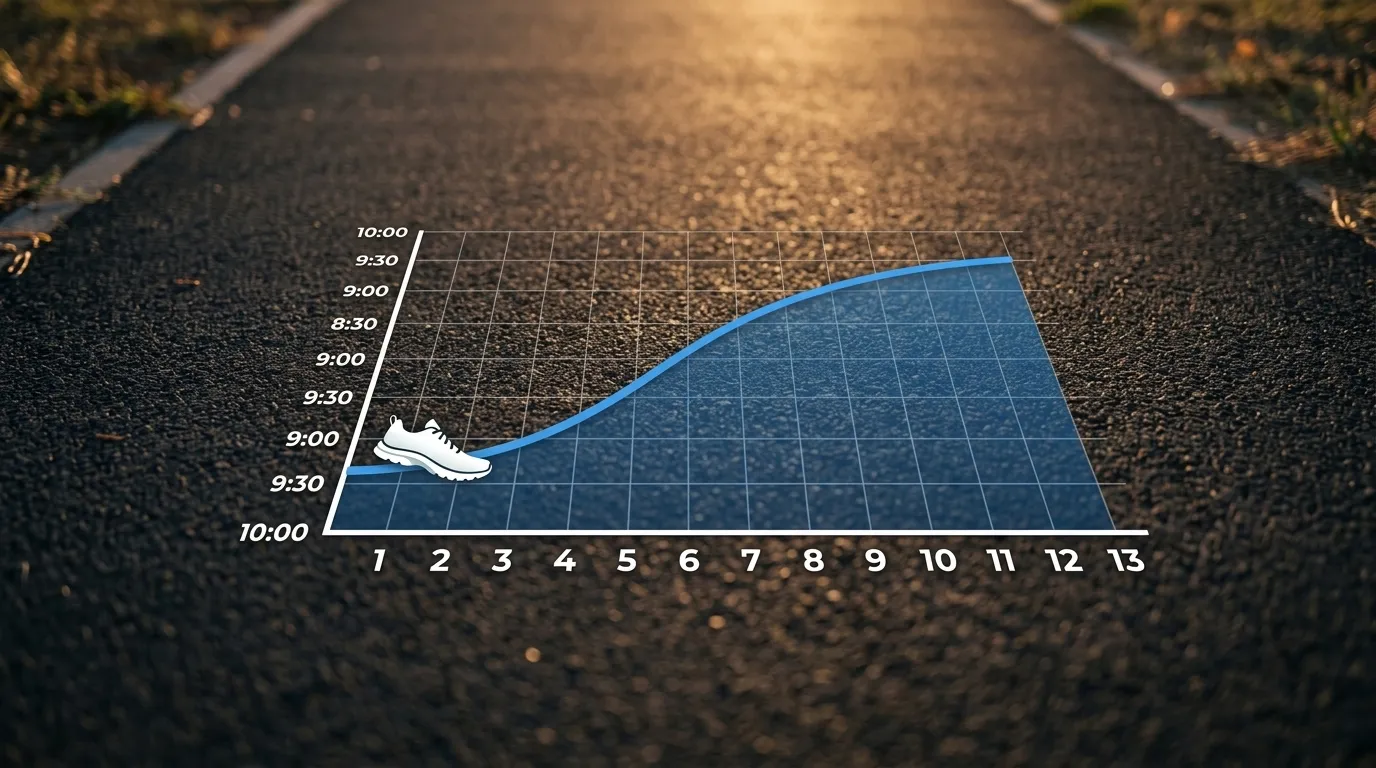
Half Marathon Negative Split Strategy
Running the second half of a half marathon faster than the first is one of the most reliable ways to set a personal best — and one of the hardest disciplines to actually execute on race day. Most runners go out too fast, pay for it at mile 9, and limp to the finish. A well-planned negative split strategy flips that script.
This guide covers the physiology behind negative splitting, the exact numbers you need to build a split plan, and how to train your body and brain to hold back when every instinct says go.
What a Negative Split Actually Means
A negative split means your second half is faster than your first. For a half marathon, that means miles 7–13.1 run at a quicker average pace than miles 1–6. It does not mean a dramatic acceleration — the difference between a well-executed negative split and an even-effort race is often just 15 to 30 seconds per mile across the back half.
The key distinction is between pace and effort. A negative split by pace is the goal. A negative split by effort is almost inevitable — your cardiovascular system takes several miles to fully warm up, so the same perceived exertion produces faster splits later in the race once your body is operating efficiently.
Note: A perfectly even split and a slight negative split are both excellent outcomes. You are not aiming to run the last mile at 5K pace — you are aiming to avoid the deceleration that kills most half marathon finishes.
The Physiology That Makes Negative Splits Work
Cardiovascular Drift and the Warm-Up Effect
In the first two to three miles of any race, cardiac output is still climbing toward its sustainable ceiling. Blood is being redirected from the core to working muscles. Muscle temperature is rising. Running at goal pace during this window costs more oxygen than it will cost at mile 6 when your system is fully primed.
Starting 10–15 seconds per mile slower than goal pace during miles 1–3 is not losing time — it is buying efficiency for the second half.
Glycogen Preservation
The half marathon sits at the upper edge of the glycogen-dependent zone. At a hard effort, you can deplete muscle glycogen enough to feel it by mile 10 if you went out too aggressively. Starting conservatively keeps you in a slightly lower intensity band early on, preserving glycogen for the final push.
Lactate Clearance
Running above your lactate threshold — even briefly — produces a lactate debt that compounds. A runner who surges through miles 2–4 because the crowd energy is high may spend miles 8–11 paying off that debt with forced deceleration. Starting at or just below threshold keeps lactate manageable and lets you push above it intentionally in the final miles when it matters.
How to Calculate Your Negative Split Targets
The math is straightforward once you have a realistic goal time. The standard approach is to divide your target finish time into two halves and offset them by 1–2%.
Step 1 — Establish a Realistic Goal Time
Your goal time should come from your current fitness, not your ambition. A race time predictor based on a recent 5K or 10K result gives you a defensible number. Plugging a recent race result into a VDOT-based calculator produces a half marathon prediction that accounts for your aerobic capacity rather than your optimism.
If you have not raced recently, use a recent long run at a controlled effort and apply a conservative adjustment. Overestimating fitness is the single most common cause of a positive split.
Step 2 — Split the Race Asymmetrically
For a 1:45:00 goal (6:05 miles average), a 1% negative split looks like this:
| Segment | Target Pace | Split Time |
|---|---|---|
| Miles 1–6 | 6:10–6:12/mi | ~37:05 |
| Miles 7–13.1 | 6:00–6:02/mi | ~37:55 → finish faster |
| Overall | 6:05/mi avg | 1:45:00 |
The difference is roughly 10 seconds per mile between halves. That is small enough to feel almost even in the early miles, but meaningful enough to produce a strong finish.
Step 3 — Build a Mile-by-Mile Split Plan
A split plan removes in-race guesswork. Rather than chasing a single average pace on your watch, you have a specific target for each mile that accounts for the course profile, weather, and your planned acceleration. The Race Split Planner in Pacesmith generates this mile-by-mile breakdown from your goal time and distance — print it, write it on your arm, or load it before you leave cell service.
The Negative Split Execution Plan
Miles 1–3: Resist the Crowd
Race-day adrenaline and a fast-moving pack will pull you out at a pace that feels easy. It is not sustainable — it just feels that way because your nervous system is flooded with cortisol. Lock onto your planned pace using your watch and ignore everyone around you. Expect to be passed. That is correct.
Target: 10–15 seconds per mile slower than goal pace.
Miles 4–6: Settle Into Goal Pace
By mile 4, your cardiovascular system is fully engaged and your pace should feel controlled but purposeful. This is where you dial into your planned average. Breathing should be rhythmic but not labored. If you are already working hard, you went out too fast.
Target: Goal pace ± 5 seconds per mile.
Miles 7–9: The Decision Point
This stretch is where most half marathons are won or lost. The early miles are behind you, the finish is not yet in sight, and fatigue starts to register. Runners who went out too fast begin to slow here. Runners who ran the first half correctly feel controlled and can begin a gradual acceleration.
If you feel good, add 5 seconds per mile of pace. If you feel neutral, hold goal pace. If you feel bad, hold goal pace and reassess at mile 10.
Target: Goal pace to 5 seconds per mile faster.
Miles 10–11: Commit
At mile 10, you have a 5K left. That is a distance you have run many times in training. Begin running by effort rather than by watch — your goal pace should now feel like a moderate push rather than a ceiling.
Target: 5–10 seconds per mile faster than goal pace.
Miles 12–13.1: Empty the Tank
Everything you conserved in the first half is available now. This is the physiological payoff of a disciplined start. Push hard. Your legs are fatigued but your glycogen stores are intact, your lactate is manageable, and you have less than 15 minutes of running left.
Target: 10–20 seconds per mile faster than goal pace, or full effort.
Training Workouts That Build Negative Split Discipline
Executing a negative split on race day requires practicing it in training. These three workouts build the physical and psychological habits you need.
Progression Long Run
Run your long run in thirds. The first third at easy pace (Zone 1–2), the middle third at marathon pace, and the final third at half marathon goal pace. This teaches your body to accelerate on tired legs and trains your brain to hold back when fresh.
For easy and marathon pace targets, a training pace calculator based on your VDOT score gives you precise zones rather than rough estimates. Running your easy miles too fast is the most common training mistake — it leaves you under-recovered and unable to hit quality in the sessions that matter.
Tempo Negative Split
Warm up for 2 miles, then run 6 miles at tempo effort: miles 1–3 at 10 seconds per mile slower than threshold pace, miles 4–6 at threshold pace. Cool down for 1–2 miles. This is a direct simulation of the back-half acceleration you want on race day.
Race-Pace Intervals With Descending Rest
Run 4 × 1 mile at goal half marathon pace with 90 seconds rest between reps, then immediately run 2 × 1 mile at 10 seconds per mile faster with 60 seconds rest. The shorter rest on the faster reps simulates late-race fatigue while training you to accelerate through it.
Common Mistakes and How to Avoid Them
Starting too fast. The most common error, and the one that makes negative splits feel impossible. Use your GPS watch as a governor in the first mile, not a motivator.
Treating even splits as failure. An even split is an excellent race. The goal is to avoid positive splits — a second half that is slower than the first. If you run even splits and feel strong at the finish, you executed well.
Ignoring course profile. A hilly course requires pace adjustments, not effort adjustments. Running uphill at goal pace costs far more than goal effort. Build your split plan around the course, not a flat-road average. The Pace Calculator lets you check segment paces against an overall goal time so the back-half average still works out.
Using an unrealistic goal time. A negative split strategy built on an overambitious goal produces a positive split race. Start with a prediction from your actual recent fitness — the VO2 Max Race Time Predictor gives you a science-based ceiling rather than a wishful one.
Tip: Run your first mile 20 seconds slower than goal pace, not 5. The discomfort of watching people pull away in mile 1 is far less painful than the discomfort of dying in mile 10.
How a Split Planner Removes the Guesswork
The hardest part of negative splitting is not the fitness — it is the in-race decision-making under fatigue and adrenaline. A printed or memorized split plan converts a complex pacing strategy into a simple per-mile checklist. You do not have to do math at mile 8. You just check your watch against your plan.
Pacesmith’s Race Split Planner generates a complete mile-by-mile breakdown from your goal time. Pair it with the Pace Calculator to verify your target paces across different course segments, and you arrive at the start line with a plan rather than a hope.
The difference between runners who negative split and runners who blow up is rarely fitness. It is almost always preparation — knowing the numbers before the gun goes off.
Build your half marathon split plan now. Enter your goal time in the Race Split Planner and get a mile-by-mile negative split breakdown in seconds — no account, no subscription, no guesswork.